

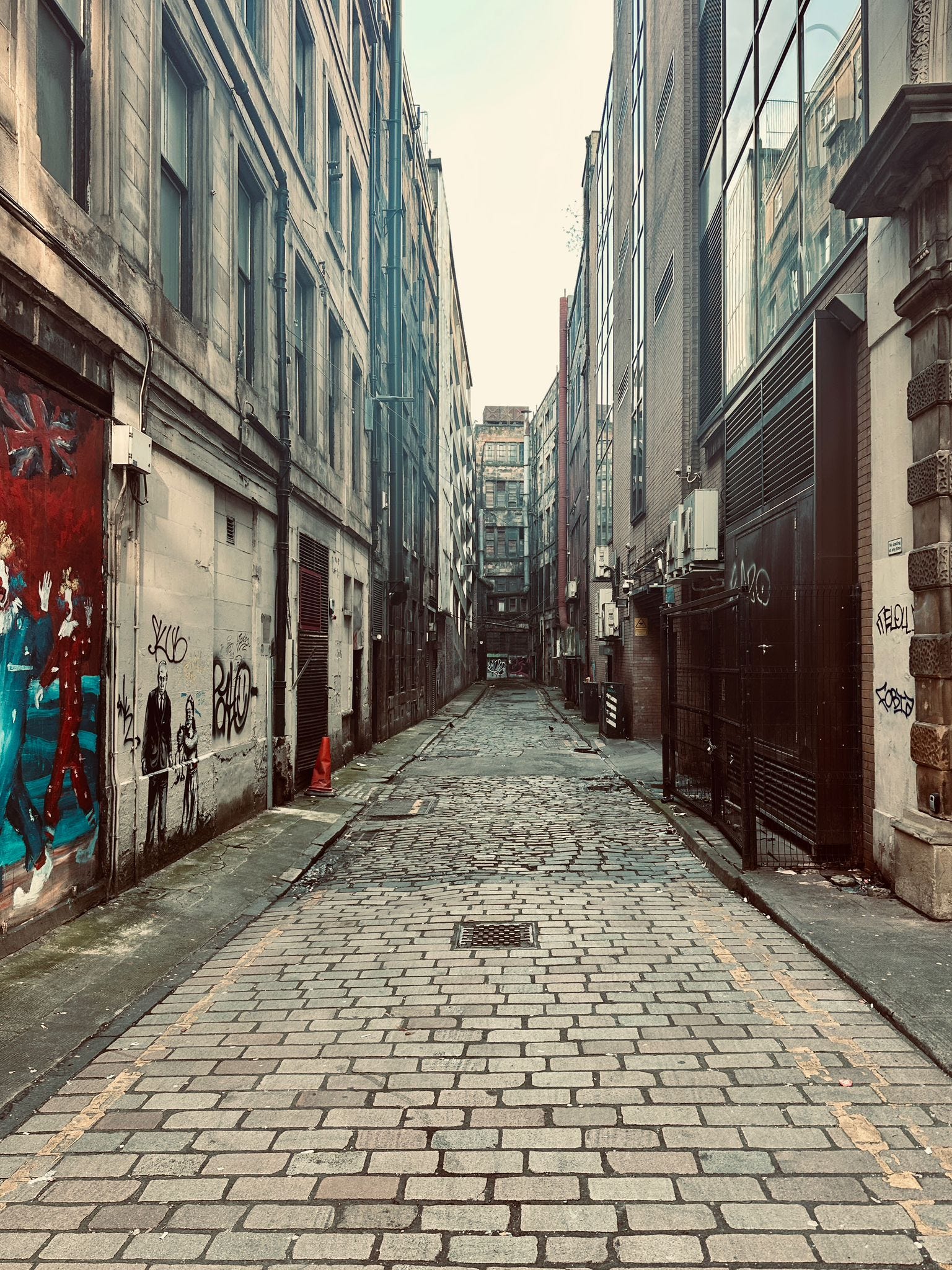
Yesterday afternoon at 15:33, I took a photograph.
It’s not much of a photograph. A narrow cobbled lane in Glasgow called Union Place, running behind the buildings beside Glasgow Central Station. Sandstone walls on either side. Pipes running down the stone. Graffiti. A slightly forgotten urban service street.
But it caught my eye.
I’d just walked down Union Street, heading for the 15:55 train to Birmingham on my way home. It had been one of those weeks back in Scotland that combine the ordinary and the important: a few days of work, a bit of time helping my ageing parents around the house, cups of tea that stretch into conversations.
The sort of week that reminds you how time quietly moves on.
There were the small family moments too. Watching Scotland rugby union team win on television with my old man (against the mighty France!!) — the sort of shared sporting joy that feels bigger than the match itself. And, inevitably, the other side of Scottish sporting life: another defeat for Airdrieonians, which by now most of us take with philosophical resignation.
Football highs and lows. Family conversations. The normal rhythm of a week back home.
And then the walk to the station.
Glasgow does something to you when you walk through it. Even if you’ve done it a thousand times, you find yourself looking up. The city’s Victorian architecture is extraordinary — sandstone buildings built in an era when Glasgow was one of the richest cities on earth.
Domes. Columns. Carved lintels. Solid walls that feel as though they were designed to stand for centuries.
I remember looking up and thinking how remarkable it is that so much of it still survives.
Then I turned down Union Place for a moment and took that photograph.
At 15:33.
About twelve minutes later, according to the reports, a fire started around the corner on Union Street.
By early evening, flames had torn through one of the very buildings I had just been admiring — a mid-Victorian block beside the station. The fire spread quickly through the structure before parts of the building collapsed.
Today, the station is closed. Businesses are gone. A piece of Glasgow’s streetscape has changed overnight.
And that unremarkable photograph on my phone suddenly feels oddly significant.
Because it captures something we almost never notice: the quiet moment before something changes.
Cities are full of those moments. We walk through them every day without realising. Streets feel permanent. Buildings feel permanent. We assume they will simply be there tomorrow.
Yesterday, for twelve minutes, they were.
Thankfully, it seems no one was seriously hurt. Firefighters did extraordinary work in what must have been incredibly difficult conditions in a dense city centre.
The city will recover. It always does.
Glasgow has reinvented itself many times across the centuries — through industry, decline, culture and renewal. Its buildings tell that story in stone.
But the photograph lingers with me.
Perhaps because it reminds us that the things we think matter in a week — a rugby result, a football defeat, the everyday chatter of life — can suddenly feel very small.
What matters more are the moments we rarely think to measure.
A walk through a city you love.
Looking up at buildings that have stood longer than any of us.
And the quiet, unnoticed twelve minutes before history changes the view.
https://www.theguardian.com/uk-news/2026/mar/09/glasgow-central-station-closed-fire
Scottie - very poignant - beautifully written and observed. To appreciate everything we've got, is so human.
It was a pleasure to grow up in and around Mother Glasgow, such a beautiful city - in many ways, from its people to the architecture. I also developed the habit of looking up at the buildings (& the rare sunshine), something I continued in every place I have worked & lived.
I shall miss that building on the corner of Union St & Gordon St. And of course the IRN BRU sign above it, which must have been there for over 60yrs. Many a walk down Renfield Street (from the Apollo) navigating towards Central using the sign on Union corner.