

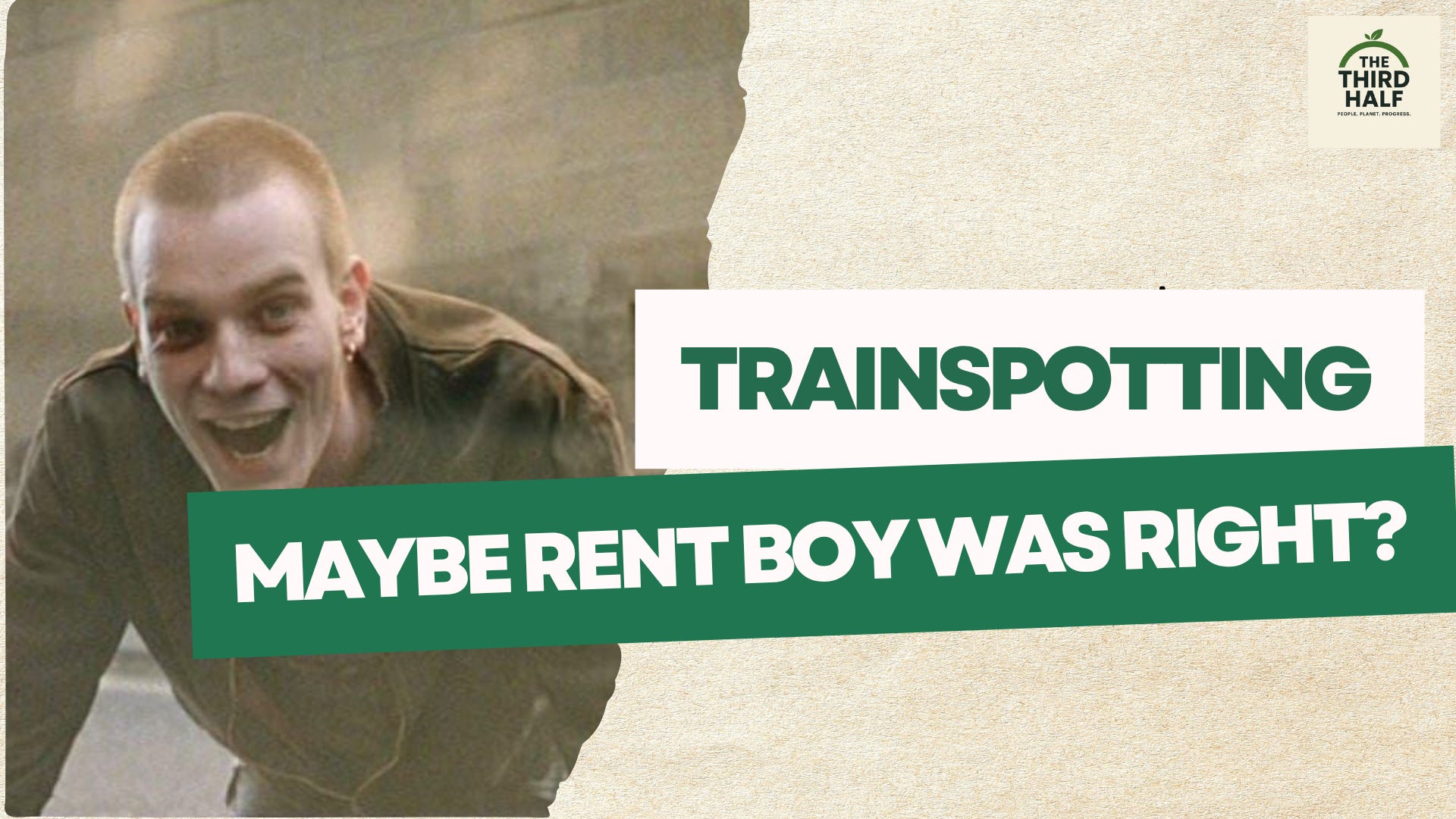
Thirty years ago, a heroin addict from Leith delivered one of the most famous monologues in British cinema.
Most of us thought it was a joke.
Looking around today, I’m not so sure. Bigger houses. Better cars. Nicer holidays.
Larger televisions. More technology. Bigger mortgages. More debt. More consumption. More stuff.
The target was always the same.
More.
My generation was raised on a fairly straightforward promise.
Work hard. Get promoted. Earn more. Buy better things. Move to a bigger house.
Take nicer holidays. Retire comfortably. Success was measurable.
You could see it on the driveway, in the kitchen extension or in the holiday photos.
And if I’m honest, I bought into it too.
Most of us did.
After all, that was the deal.
The harder you worked, the more rewards you accumulated.
That wasn’t greed. That was aspiration.
Today I was reading an article about a group of economists who argue that rising inequality and environmental pressures are heading towards a collision course.
The report itself wasn’t what caught my attention.
What caught my attention was how quickly the debate became tribal.
Tax the rich. Don’t tax the rich. Climate crisis. Climate nonsense. Capitalism. Socialism.
The usual modern shouting match.
Yet I found myself thinking about something else entirely.
What if we’re debating the wrong question?
Maybe the issue isn’t who gets the biggest slice of the pie.
Maybe it’s whether we’ve built a system that only works if the pie keeps getting bigger forever.
Because that’s what we’ve spent most of our lives doing.
Growing. Consuming. Expanding. Upgrading. Accumulating.
Always assuming the next version would be better than the current one.
I spent most of my career in technology.
If any industry embodies this mindset, it’s ours.
More software.
More platforms.
More subscriptions.
More cloud.
More devices.
More data.
More complexity.
Technology has undoubtedly improved lives. Better healthcare. Better communication. Better access to knowledge. Better opportunities for millions of people.
But even technology seems trapped by the same assumption as the rest of society.
That bigger is always better.
That growth is always progress.
That enough is a destination nobody should ever reach.
The older I get, the less convinced I am.
Not because I’ve suddenly become anti-business.
Quite the opposite.
Business creates jobs, opportunities and prosperity.
Not because ambition is wrong.
Ambition is often what drives positive change.
And certainly not because people shouldn’t enjoy the rewards of hard work.
They absolutely should.
But somewhere along the way we’ve started confusing accumulation with success.
A bigger house doesn’t automatically create a happier family.
A better car doesn’t automatically create a better life.
Another overseas holiday doesn’t automatically bring fulfilment.
And the latest technology doesn’t automatically solve the problems that matter most.
Sometimes it simply creates a newer version of the old ones.
The uncomfortable truth is that the world has never been wealthier.
Technology has never been more powerful.
Human ingenuity has never been greater.
Yet anxiety seems everywhere.
Trust feels lower.
Politics feels angrier.
Communities feel weaker.
And despite all our progress, we’re still arguing about what a good life actually looks like.
Perhaps that’s why this debate matters.
Not because of climate activists.
Not because of economists.
Not because of billionaires.
Because sooner or later every generation has to decide what success means.
For most of my life, success was measured by more.
More money. More house. More holidays. More technology. More consumption.
Maybe Rent Boy’s joke wasn’t really a joke after all.
Maybe it was a warning.
The awkward question facing all of us now is whether we’ve finally reached the point where “more” and “better” have stopped being the same thing.