

Every other week I sit with my parents. They are in their eighties now, and I watch the decline. That is not a cruel way to put it. It is just honest. They had good lives and they worked hard and their bodies are doing what bodies eventually do.
But here is the thing that stays with me. When my mum and dad were in their sixties, they were fit and well. That decade felt like the reward. The work done, the kids grown, the energy still there. A Third Half, before we had a name for it.
New research published today suggests that for many people in the UK, that window is closing.
The Health Foundation analysed data across 21 wealthy nations and found that the average British man now spends only 60.7 years in good health, down from 62.9 a decade ago. For women, it has fallen from 63.7 to 60.9. The UK has dropped from 14th to 20th in international healthy life expectancy rankings. Only the United States is below us. Japan, Norway, Spain, all heading the right direction. We are going the other way.
The number that cuts deepest: across more than 90% of the country, people now begin experiencing illness before they reach state pension age of 66. Before they even get to stop.
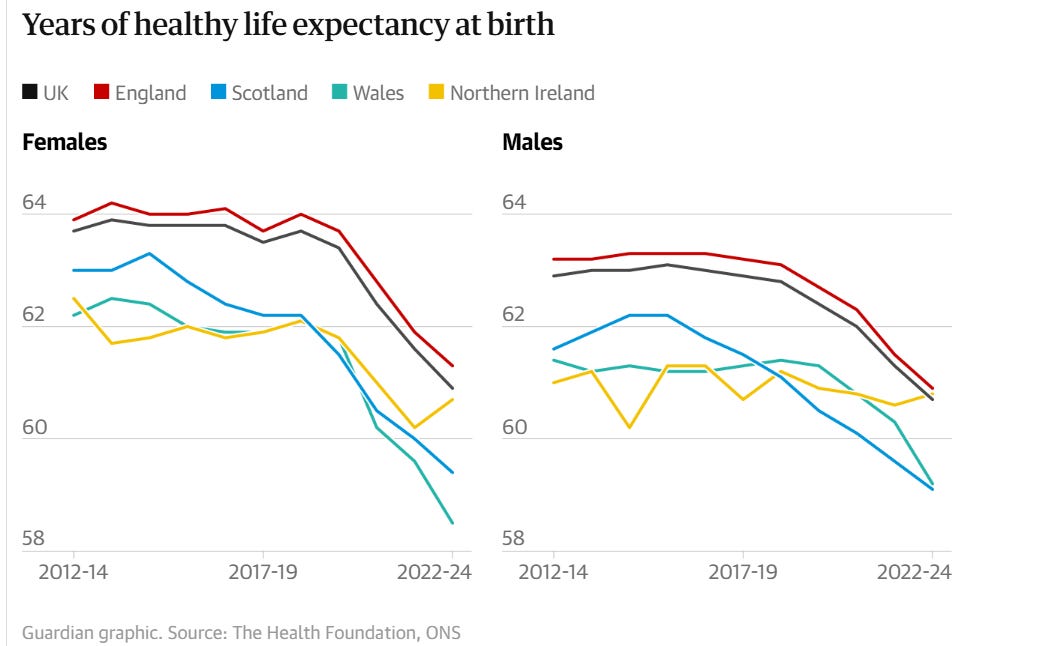
And yes, before you ask the obvious question – life expectancy itself has not collapsed. People are still living roughly as long. Which means we are adding years without adding health. The extra time is not the good kind. We are living longer into decline, not longer in good shape.
The causes are not complicated to name. Obesity, now the worst in Western Europe. Alcohol. Mental illness at record levels. The geography of it is brutal too. Men in Richmond upon Thames average 69.3 healthy years. Men in Blackpool average 50.9. That is not a gap. That is a different life entirely.
The Third Half is built on an assumption: that you have enough health to make choices with. Reinvention, purpose, giving something back. None of that is possible if chronic illness arrives before you reach 66, which for most people in this country, it now does.
My parents are in their eighties and I see the reality of late decline up close. What I want, for anyone reading this, is for that phase to come as late as it possibly can. That the sixties feel the way they felt for my mum and dad. Capable. Present. Still in the game.
Right now, the data says too many people are not getting that. And that should bother all of us enough to say so.
Feels like we’re quietly losing the good years between working life and old age, and normalising it too much