

Earlier today, the headlines broke across the national press: the UK music industry has surged to a record high of £8.4 billion. Powered by stadium sell-outs from Oasis, massive international exports, and fans shelling out eye-watering, three-figure sums for arena tickets, the business looks - at least on an executive spreadsheet - like a juggernaut firing on all cylinders.
Yet, tucked beneath the triumphant press releases sits a far darker statistic: while earnings for top- and mid-tier artists jumped by more than 14%, income for the broader community of working creators grew by a staggering, almost imperceptible.
How do you reconcile an industry awash with billions with an ecosystem where grassroots musicians can barely afford petrol to get to their next gig, and local stages are vanishing by the month?
The answer is something Mark Davyd, founder and CEO of the Music Venue Trust (MVT), laid bare when he sat down with me on The Third Half.
The live music economy has split in two. At the summit, you have corporate finance harvesting unprecedented returns. At the bottom, you have the cultural research and development of British music - the dark, sweaty rooms where teenagers learn how to play - operating on volunteer grit and financial fumes.
As Mark put it to me with blunt clarity:
“At the top end, everybody’s got a calculator and nobody really cares. But this part of the industry is so human... It’s absolutely driven by a kind of human spirit.”
The Pizza Oven Principle
If you judge a grassroots music venue solely by modern commercial capitalism, it shouldn’t exist. Mark described what happens when standard business logic meets an independent music room:
“If you ever introduce them to a normal accountant and they did an audit, the accountant would just look at them and say: ‘See all that PA equipment you’ve got there and that big stage? If you put a pizza oven there, you could take five times the amount of money that you’re taking.’ And they will just look at that accountant and go: ‘Yeah, but I don’t wanna do that.’”
There is an old, bitter joke in the sector that Mark shared: How do you make a million pounds running a grassroots music venue? Start with two million.
Nobody opens a basement venue or converts an old public toilet - as Mark and his friends did with The Forum in Tunbridge Wells back in 1993 - to get rich. They do it because of an obsessive, magnetic pull toward live music. They do it to clean toilets at 3:00 AM, put up stages in weird spaces, and give unknown kids an audience.
The fatal flaw of modern music economics is that the corporate behemoths at the top of the pyramid treat that goodwill as a permanent, free subsidy.
Who Funds the Tuesday Nights?
When Oasis announced their monster reunion tour, sparking the multibillion-pound windfall celebrated in today’s reports, the promotional machinery swung into action. But Oasis did not emerge fully formed into Wembley Stadium.
They honed their trade in places like The Princess Charlotte in Leicester.
“It’d be easier to tell you the bands that didn’t play there,” Mark reminded me. “Oasis played there. Everybody played there. And then it was gone. These days it’s a men’s clothing shop. And you’re like: what about all the joy, the creativity, and the social gathering that took place there?”
The tragedy is that the stadium promoters raking in hundreds of millions are structurally incapable of replacing what they consume. Mark pointed out the market’s blind spot:
“The work these venues do is work that’s never gonna be done by a Live Nation, a Kilimanjaro, an SJM, or an AEG. They’re never gonna put on a Tuesday night featuring three artists who have never played a stage before. It doesn’t make any sense, and they wouldn’t even really know how to do it. But if you don’t do that bit, you don’t have anything else.”
When you extract all the value from the top of an ecosystem while refusing to invest in the soil, the soil eventually dies. When the London Astoria was demolished, Mark noted that the silence from the wider music industry was deafening: “Nobody was doing anything about it. If you wanted to close the Astoria, you should have been legally compelled to build a replacement.”
This sits right at the heart of so many conversations we’ve had on The Third Half. You see it across the entire spectrum: veteran artists who have spent decades dedicating their lives to their craft - people like Martin Metcalfe (Goodbye Mr. Mackenzie, The Filthy Tongues), Rachael Wood (The Wedding Present), folk songwriter Alan Young (Serious Child), Anna Howie, and Kris and Joe Hughes (My Girl The River). They are still writing, still releasing brilliant new records, and still putting in the graft night after night to fill independent rooms of fifty, a hundred, or two hundred people. Fyfe Dangerfield is brilliantly doing his own thing on The Stream - because he wants his music in all it’s forms, to be heard. And you see this same hunger in some of the new bands coming up behind - like Marseille and Butane Skies - who are loading their own gear into vans (or their parents cars!), cutting their teeth in cramped backrooms, and fighting to build an audience stage by stage. These aren’t corporate balance sheets; they are working musicians putting everything on the line. But when those very rooms are priced out, converted into flats, or told to install a pizza oven instead, where does that journey begin - and where does a lifelong creative life actually go?
Taking the Land Out of the Market
Because unbridled commercial landlordism will happily turn every independent stage into luxury flats or retail units, Mark and the Music Venue Trust stopped asking for permission. They started redesigning the model from the ground up.
When MVT started twelve years ago, over 90% of grassroots venues were on fragile, short-term commercial leases - frequently with less than a year left, leaving them vulnerable to rent hikes and eviction. Less than 3% operated as not-for-profits.
Today, through sheer persistence:
Over 38% of grassroots venues are now run as non-profits, CICs, or community benefit societies (heading towards 50% within two years).
Music Venue Properties has stepped in to permanently buy the freeholds of venue buildings. Fans and locals can buy community shares - ensuring those rooms cannot be sold out from under the musicians.
Instead of merely subsidising crippling overheads, they are putting solar panels on venue roofs to cut electricity bills and break dependence on predatory energy tariffs.
As Mark put it: “All of the stuff we’re doing comes under one big motto: we don’t just want to fund the problems, we want to actually fix them.”
Beyond the Calculator
It is easy to look at an £8.4bn headline and assume British culture is thriving. But culture is not measured in gross export revenues or ticket surge pricing.
Culture is what happens in the Keith Moon bar, or down at The Windmill in Brixton when a metal band hands over to an electronic flugelhorn player. It is what happens at the Hebden Bridge Trades Club, or at that annual Bowie night in Tunbridge Wells where 250 local people scream their lungs out to someone who has never sung on a stage before.
It is, as Mark described, “people banging drums together for 50,000 years”—an irreplaceable, vibrating human connection that no algorithm or stadium video screen can replicate.
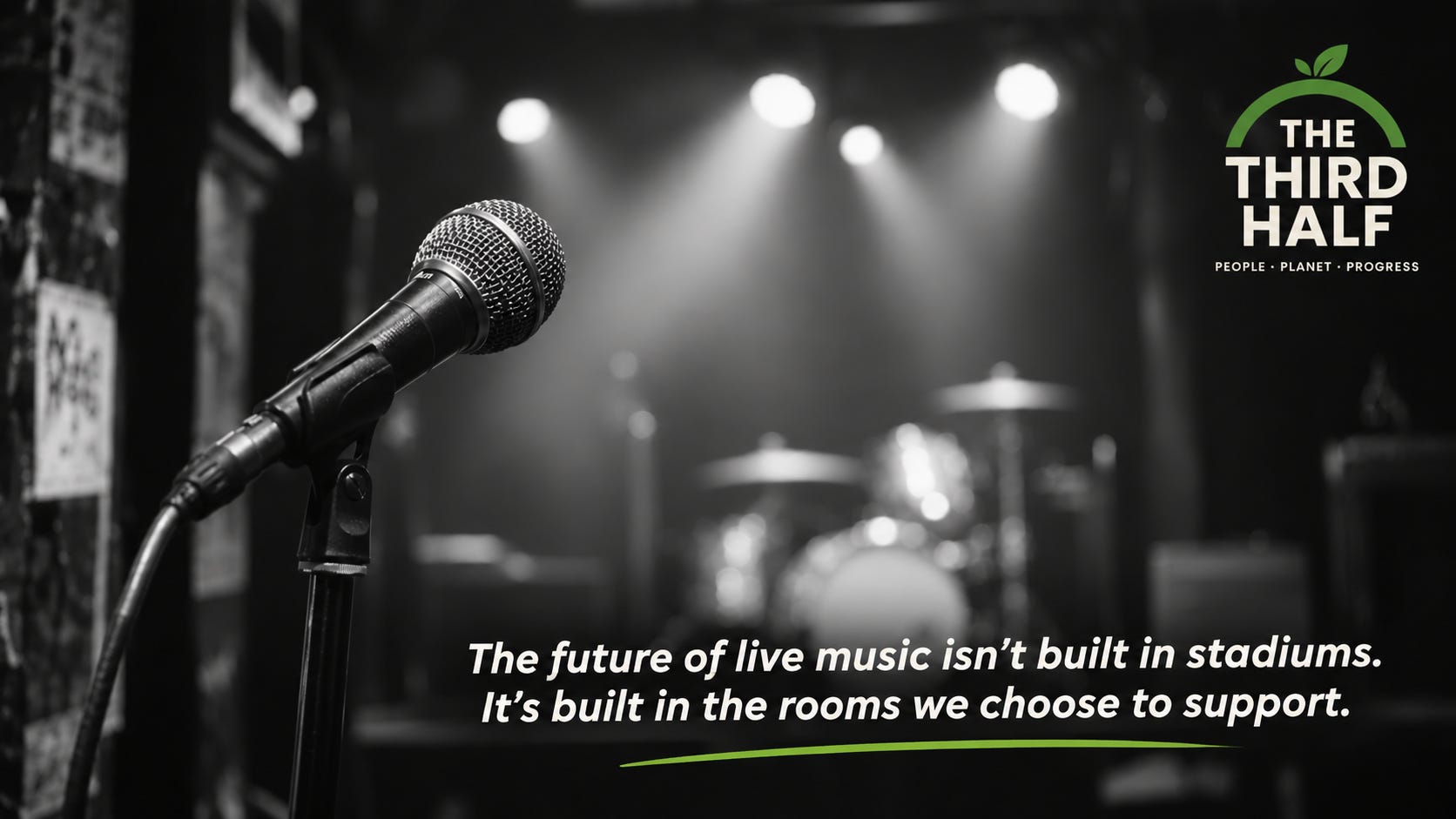
If we want British music to have an £8bn future ten years from now, we have to protect the places where it begins. And that doesn’t just mean lobbying government; it means what we choose to do with our own Friday nights.
“The most simple thing,” Mark urged, “is just go to the gig you weren’t gonna go to at your local venue. Find that £10 or £15 extra. Look for the band with the wackiest name that you definitely don’t want to see, and go. You never know what you’ll find.”
Go buy the ticket. Have a beer. Support the room. Because when the calculators finish tallying the stadium profits, those little stages are the only reason the music exists at all.
Listen to the full conversation with Mark Davyd on The Third Half on Substack, Spotify, or Apple Podcasts.