

Everyone, it seems, is a storyteller now.
Spend ten minutes browsing professional networks or listening to corporate leadership panels, and you will hear a relentless sermon on narrative, personal branding, and resilience. Yet so often, the advice is dispensed from the deep comfort of a twenty-year career swim lane - preaching company-approved medicine from inside an air-conditioned safe space, to colleagues, with colleagues, about colleagues.
People need to get out more.
Don’t get me wrong. There are brilliant, captivating speakers in the corporate world. But being a slick presenter does not make you a storyteller. Delivering a rehearsed keynote with elegant slides is performance, even with - as is often the case - bags of charisma, but it’s usually to a formula you’ll find in ‘How to tell a good story 101” (£9.99 online, usually free in the staff canteen); it is rarely hard-earned truth with the blood and gore left in.
I certainly don’t profess to be a great storyteller myself. But over the past year, hosting The Third Half, I have become something else: a passionate, quiet collector of great stories.
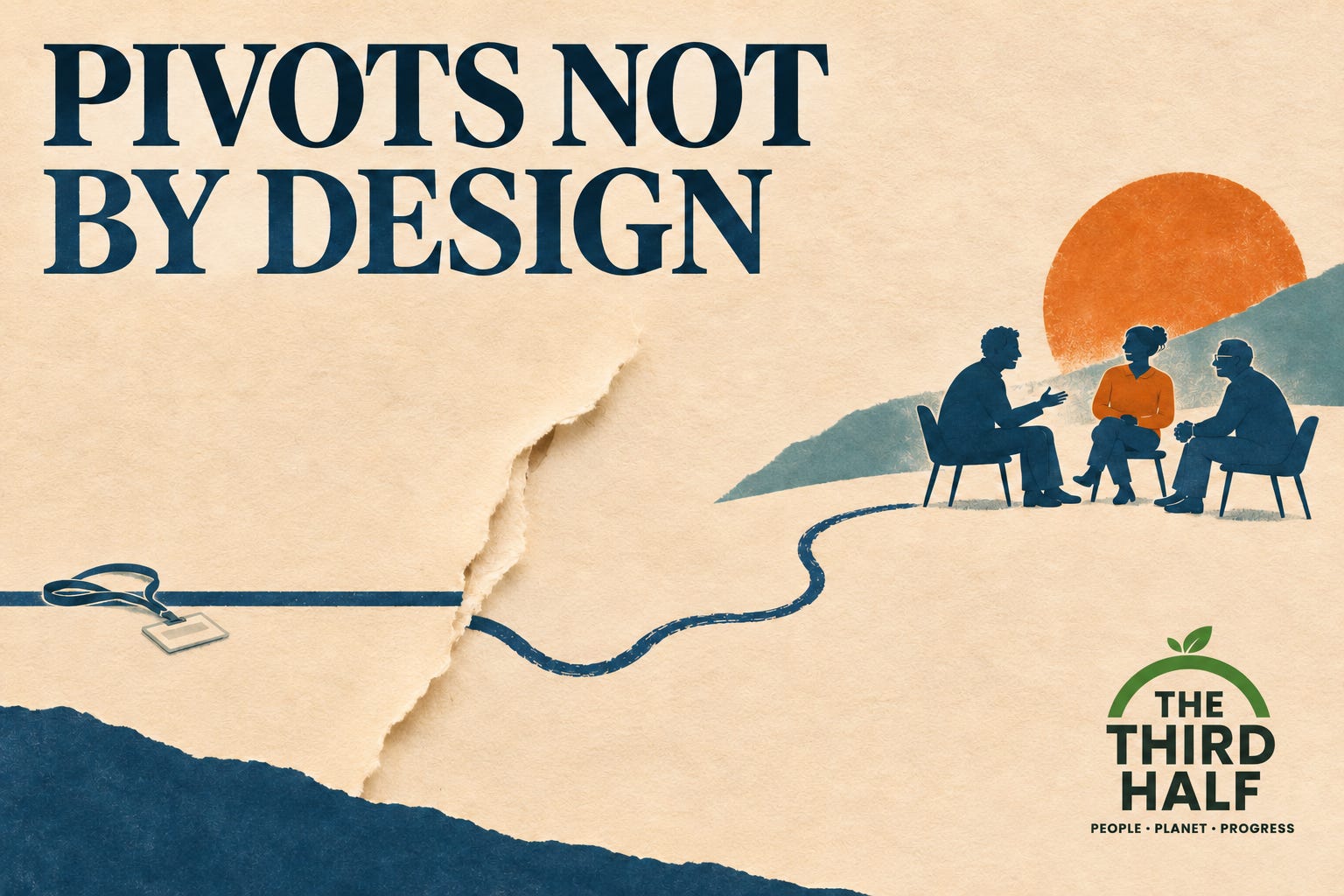
We are now nearly 50 interviews in. And what we have is clear - that there are plenty of self-determined pivots in life, but sometimes the most profound learnings come from the pivots “not by design”- the moments when life unceremoniously rips the steering wheel from your hands, delivers a blow you never asked for, and demands to see who you actually are beneath the titles.
And these make great stories, and ultimately, great storytellers.
Over recent weeks, three conversations in particular come to mind:
Alex Millar: From Window Cleaner to The Gadgies
Alex spent four decades cleaning windows. At 42, his entire world disintegrated: he lost both of his parents within three months, walked away from a lifetime in a strict religious community, lost his home, and found himself sleeping in his car.
Leading up to and during the depths of raw, disorienting grief, he picked up a pencil simply to make his ailing father smile, sketching the older working men with baggy trousers and flat caps he remembered from his native home in Ayrshire to outside the pubs and shipyards of Newcastle. Those private sketches became The Gadgies - an iconic body of work now celebrated and collected worldwide. His art wasn’t born in an academy; it was clawed out of complete breakdown. We published our conversation with Alex this week.
Derek Lynch: The 20-Minute Morning Diagnostic
Derek was living the high-octane international corporate life, flying across borders and executing complex commercial deals. Out of nowhere, Addison’s disease and an acute adrenal crisis brought him within hours of death.
Confronting an invisible, life-threatening condition forced him off the relentless corporate treadmill. It changed his entire relationship with ambition. When we spoke, Derek described a morning ritual that lays bare the reality of his day: “The first twenty minutes of every day, I have to lie there, assess my body, and know whether I’m safe.” That daily reality check recalibrated everything - stripping away corporate trivialities and focusing him entirely on what truly matters.
Matt Ryan: Perspective in the ICU
Matt, a farmer by trade, helped build and scale an empire of 47 hospitality venues and nearly 2,000 staff across Ireland. He knows the live-fire intensity of business as well as anyone. Yet the crucibles that forged his core had nothing to do with turnover or expansion.
They happened when he lost his beloved mother, to a sudden, tragic medical crisis. And they happened when a consultant walked into an ICU room at 10:00 AM to deliver a devastating bacterial meningitis diagnosis for his two-week-old son.
Surviving those moments fundamentally re-anchored how Matt sees the world. When colleagues bring him a “crisis” in business today, he struggles to view it as a disaster. Having faced problems that carried zero easy answers, you realise that almost everything else in business is figure-outable.
Both Derek and Matt are edit at the moment - can’t wait to get these convos live.
No Victims, No Sympathy
When you sit across from Alex, Derek, and Matt, not one of them behaves like a victim. Not one of them is looking for an ounce of sympathy.
There is zero self-pity in their voices. Instead, you encounter a quiet dignity, an infectious sense of humour (I laughed - a lot - with all three of them), and an enviable clarity about what matters. In a week dominated by relentless, exhausting, sometimes horrific news cycles from the UK and around the world, spending time with people like them makes me feel genuinely positive about humanity. How they cope, adapt, and move forward is a masterclass for all of us.
Then Matt said something right at the close of our recording on the nature of change: the premeditated career moves we love to map out on paper, versus the choiceless pivots that circumstance forces upon us.
Through every boardroom storm and personal trial, Matt is the first to tell you that his family and his wife in particular was and is, his absolute rock. And in a society endlessly obsessed with status, metrics, and outward accolades, his parting perspective felt like the real takeaway: ‘protect your nearest and dearest, stay present for your family, and look after your people’. How good is that.
This all, for me, is the magic of The Third Half. It’s not about coaching or corporate platitudes. It’s simply about holding a space where the armour drops, the safe corporate lane disappears, and the real stuff surfaces.
As we approach our 50th episode, I’d love to hear from you:
Have you ever experienced a life pivot that wasn’t of your own design? How did it change your perspective on what counts?
If you have an unscripted story of unexpected change that belongs on the show, or if you are navigating a major life transition and just need a confidential sounding board, hit reply. My door is always open.