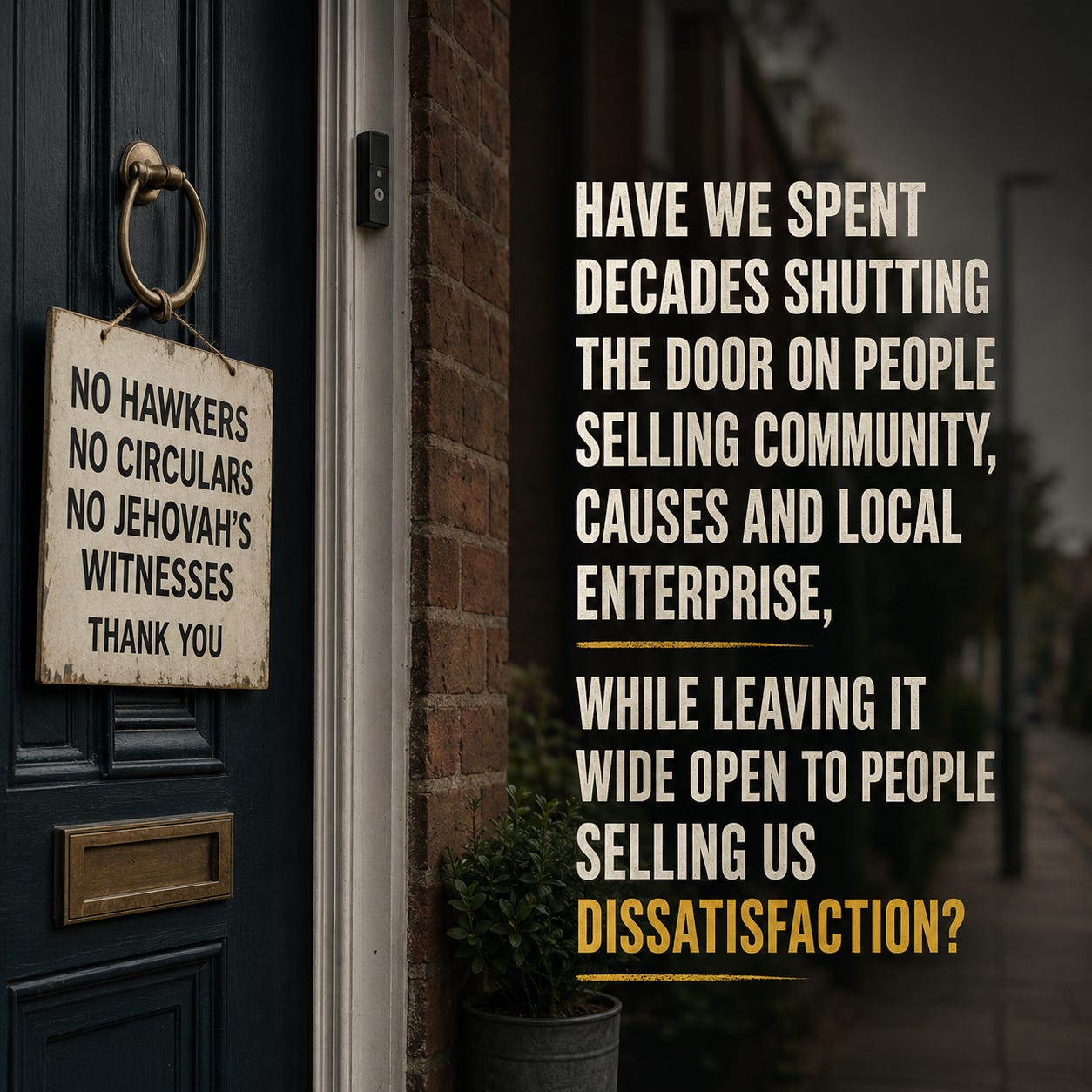
Jehovah’s Witness(es?) called today. Lovely, polite, I was on a call, they passed a card and moved on. No foot in the door. Hours later I passed a garden gate - was out walking Barney - and a sign said boldly ‘No Hawkers or Circulars’. I thought yep, not for me either.
But…. I started to think.
We know the signs. We’ve probably all thought about putting one up.
Don’t knock on my door. Don’t put stuff through my letterbox. Don’t try to sell me something I didn’t ask for.
Fair enough.
Except we spend the rest of our lives being sold things we didn’t ask for.
The new SUV that suggests our perfectly serviceable car isn’t quite good enough anymore. The watch that signifies success. The kitchen that suddenly looks dated. The holiday everyone else seems to be having. Deliveroo when there’s food in the fridge. A £1,200 phone that’s fractionally better than the £1,000 phone we already own. Klarna making something we can’t afford feel strangely affordable. Dating apps quietly suggesting there might always be someone better if we just keep swiping.
Upgrade your phone, your car, your house, your teeth, your body, your holiday. Upgrade your life.
(I’ve gone a bit Trainspotting again).
An awful lot of modern advertising isn’t really selling us products. It’s selling us dissatisfaction with what we already have, and we barely notice it anymore.
But put a badly photocopied circular through the letterbox and it’s outrage.
Except who’s actually sending those circulars? The local Indian restaurant. A window cleaner. Someone who’s just started a gardening business. A plumber. The village fete. A charity shop looking for donations.
And those dreaded “hawkers” we want to avoid? Yes, sometimes they’re flogging rubbish. But quite often they’re asking us to give a few quid a month to a charity, and we’ll slam the door or cross the road to avoid them while drinking a £4 coffee we’ve just been persuaded 20 mins earlier we needed.
Then there are Jehovah’s Witnesses. For the avoidance of doubt, I’m not religious and I don’t want converting. But strip away whether you agree with them and consider what they’re actually offering: their version of meaning, faith, community, a better way to live. You can completely reject their answer while acknowledging that those aren’t inherently terrible things to advocate for.
Which leaves us with a rather weird hierarchy of acceptable persuasion. Someone knocks on our door and says you might be happier if you found God, and they’re an irritating nuisance. A multinational corporation, armed with an extraordinary amount of information about us (bloody algorithms), whispers you might be happier if you bought this, and that’s just everyday life. One asks for five minutes of our attention. The other has built an entire economy around capturing as much of it as possible.
Perhaps there’s a consequence. We have more possessions, more convenience, more choice and more ways to consume than any generation before us. Yet we talk endlessly about loneliness, debt, anxiety, disappearing communities, struggling local businesses and the nagging feeling that somehow our lives don’t quite measure up.
I’m certainly not suggesting the answer to modern society is Jehovah’s Witnesses and a bloke selling dusters at the front door. But I do wonder whether we’ve spent decades shutting the door on people selling community, causes and local enterprise, while leaving it permanently open to people selling us dissatisfaction.
Maybe we’ve got the sign on the wrong door.
Scott
People. Planet. Progress. #TheThirdHalf #Community #Consumerism #PPP