

Over the years she’s been an athlete, broadcaster, psychologist and coach. Like a lot of the people we feature on The Third Half, she’s never been particularly interested in staying in one lane.
I’ve known Pip for more than thirty years, long before The Third Half existed. Back then I was busy building a career in technology and business while Pip was carving out a fascinating path of her own.
These days we’re both exploring different territory. For me, that’s meant writing, chatting with interesting people and building The Third Half. For Pip, it has increasingly meant painting.
I now have three of her paintings hanging on my walls, which probably tells you more about what I think of her work than any introduction ever could.
We recently caught up to talk about creativity, confidence, finding your voice, and why some paintings are much harder to let go of than others.
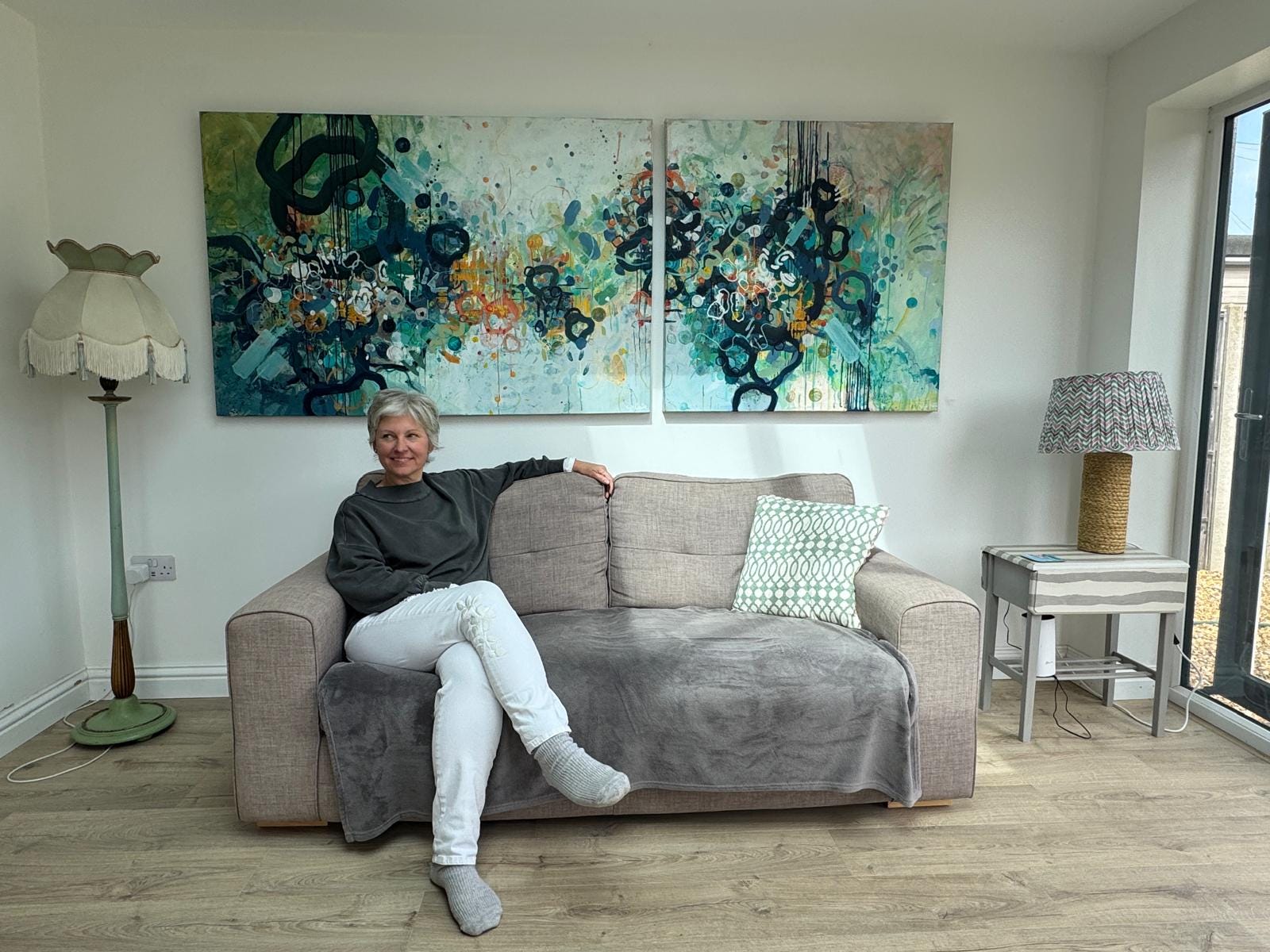
The First Sale
Scott: Do you remember the first piece you ever sold?
Pip: I do, actually, although it’s probably not the answer people expect. It wasn’t a recent painting, and it certainly wasn’t hanging in a gallery.
I was in my twenties, and it was a life drawing, a reclining nude, done in charcoal and chalk on a great big sheet of sugar paper. Fairly simple piece, looking back, but it mattered because it was the first time somebody outside my immediate circle wanted to buy something I’d actually made. You know what it’s like with friends and family, they’re lovely, but there’s always that small suspicion they’re just being kind because they know you. This was different. Someone I barely knew saw it, liked it, and wanted to take it home.
I sold it for £25 and thought I’d done brilliantly. Honestly, the money was never really the point, it was the fact that something I’d made out of my own head had connected with a complete stranger.
The Painting She Almost Didn’t Sell
Years later there was another one that mattered for completely different reasons. It was called Bali Garden, and it was in my first solo exhibition. I hung the show, went home feeling perfectly calm about the whole thing, and then lay awake half the night thinking, I don’t actually want to sell that painting. I’d spent so long with it by then, it felt like part of me.
So the next morning, before the doors even opened, I went back and put the price up. Which, looking back, wasn’t really a commercial decision at all, it was a slightly desperate attempt to put people off buying it. Didn’t work, obviously. Sold almost straight away.
But here’s the good bit. I know exactly where it is. It’s hanging in the home of somebody I like enormously, and we’ve stayed in touch all these years. And then I found out, quite by accident, that they’ve put it in their will. One day it’ll pass to their son. I know that sounds terribly sentimental, but it genuinely does something to me, knowing that.
That’s the thing about paintings, isn’t it. You spend hours with them, you wrestle with them, sometimes they drive you mad and sometimes they surprise you, and then off they go and belong to somebody else entirely. Knowing where that one’s going to be, long after I’m gone, that’s rather a lovely thought to carry around.
More Than a Creative Outlet
Scott: Listening to you talk about that, it feels as though art is much more than a creative outlet.
Pip: It is now, though it took a while to get there, if I’m honest.
You’ve known me for over thirty years, Scott, so you’ve seen the different versions of me, all the different chapters. Like most people I’ve had successes, disappointments, changes of direction, moments where I’ve basically had to start again. And art has turned up at exactly the right point in my life for all that, I think.
What it gives me is hard to put into words, because it’s not really about the painting itself. It’s about having somewhere to think. Somewhere to reflect, without feeling like you have to justify the thought before you’ve even had it properly.
I listened to your conversation with April De Angelis the other week and found myself nodding along the whole time. She wasn’t really talking about writing, not the actual writing bit, she was talking about everything that happens before it. The thinking, the noticing, just wandering about letting ideas turn over before they ever land on a page. Painting’s very similar. People imagine artists stood at an easel producing work all day long, but honestly, most of the actual creativity happens before a brush ever touches the canvas.
I read your piece on making space for imagination as well, and it reminded me how often the best ideas turn up when you’ve stopped actively hunting for them. When I’m working on a collection I tend to just disappear. Phone goes off, emails can wait, I shut the studio door and that’s it, I’m in there. Sometimes that’s a day, sometimes it’s three or four. I’m sure from the outside it looks faintly antisocial, but it isn’t really, it’s just what the work needs. Time, attention, and most of all, space.
Movement in the Work
Scott: One thing I’ve always noticed about your work is that even the most abstract pieces seem to contain movement.
Pip: I suspect that’s because movement has shaped most of my life, if I think about it. Sport, broadcasting, all of it, I’ve always been drawn to energy and momentum, what’s actually going on underneath things rather than what’s sitting on top.
People look at a painting and ask what it’s of, and the honest answer is usually that I’m trying to capture a feeling rather than a subject. A landscape might be the starting point, but the finished piece isn’t really about the landscape, it’s about what the landscape felt like standing there. Same with flowers, water, weather, sometimes even a conversation I’ve had. The feeling interests me far more than the object does, and that’s probably why abstract work suits me so well. It lets me chase the experience of a thing rather than worry about getting it accurate.
Why the Arts Matter
Scott: The arts seem to come up repeatedly on The Third Half these days. Music, theatre, writing, painting. Why do they matter?
Pip: Because they help us understand ourselves, I think. Simple as that, really.
I loved your piece on Ireland, by the way, the respect it showed for a culture that actually values its writers, musicians, artists, storytellers, where creativity isn’t treated as a bit of an extra but woven right through everyday life. We’ve got very good, I think, at measuring the things that are easy to count, and not nearly so good at noticing the things that are harder to measure. Art sits firmly in that second pile.
Most of us can think of a song that got us through a rough patch, a book that changed how we saw something, a painting that made us stop a moment longer than we meant to. None of that’s an accident. The arts get at parts of us that don’t respond particularly well to spreadsheets and performance metrics, which is part of why I like what you’re doing with The Third Half, if I’m honest. The conversations aren’t really about sectors or job titles, are they, they’re about people, curiosity, experience, starting again. Art belongs right in the middle of that, same as business does, same as sport does.
What's Next
Scott: So where does all this go now?
Pip: The thing taking up most of my head space at the moment is something called Bylines. I’m being quite careful about how much I say, actually, because it’s still finding its shape, but it’s probably the closest I’ve come to pulling together all the different bits of my life into one place.
It draws on my years interviewing elite athletes, sportspeople, and how often those interviews left me with this odd, very physical response. I could feel the energy in what people were telling me, the intensity, the movement of it, and that’s what the paintings are chasing. In a funny way it’s the broadcaster, the athlete and the artist all turning up in the same room, which I quite like the idea of.
I’m also looking at exhibition opportunities in London later this year. Exciting and slightly terrifying in roughly equal measure, that one. But that’s half the joy of exhibiting, isn’t it, the conversations people have around the work afterwards. No two people ever see the same painting in quite the same way, and I never get tired of that.
Pip has completed two solo exhibitions and numerous group exhibitions over the years and is currently exploring opportunities to exhibit in London this autumn.
If you’re connected to a gallery, creative venue, arts organisation or interesting space that supports artists, she’d be delighted to hear from you.
You can see more of her work at www.pipmoleart.com.
As for me, three of her paintings already hang on my walls. I have a feeling there may be more to come.
People. Planet. Progress.