

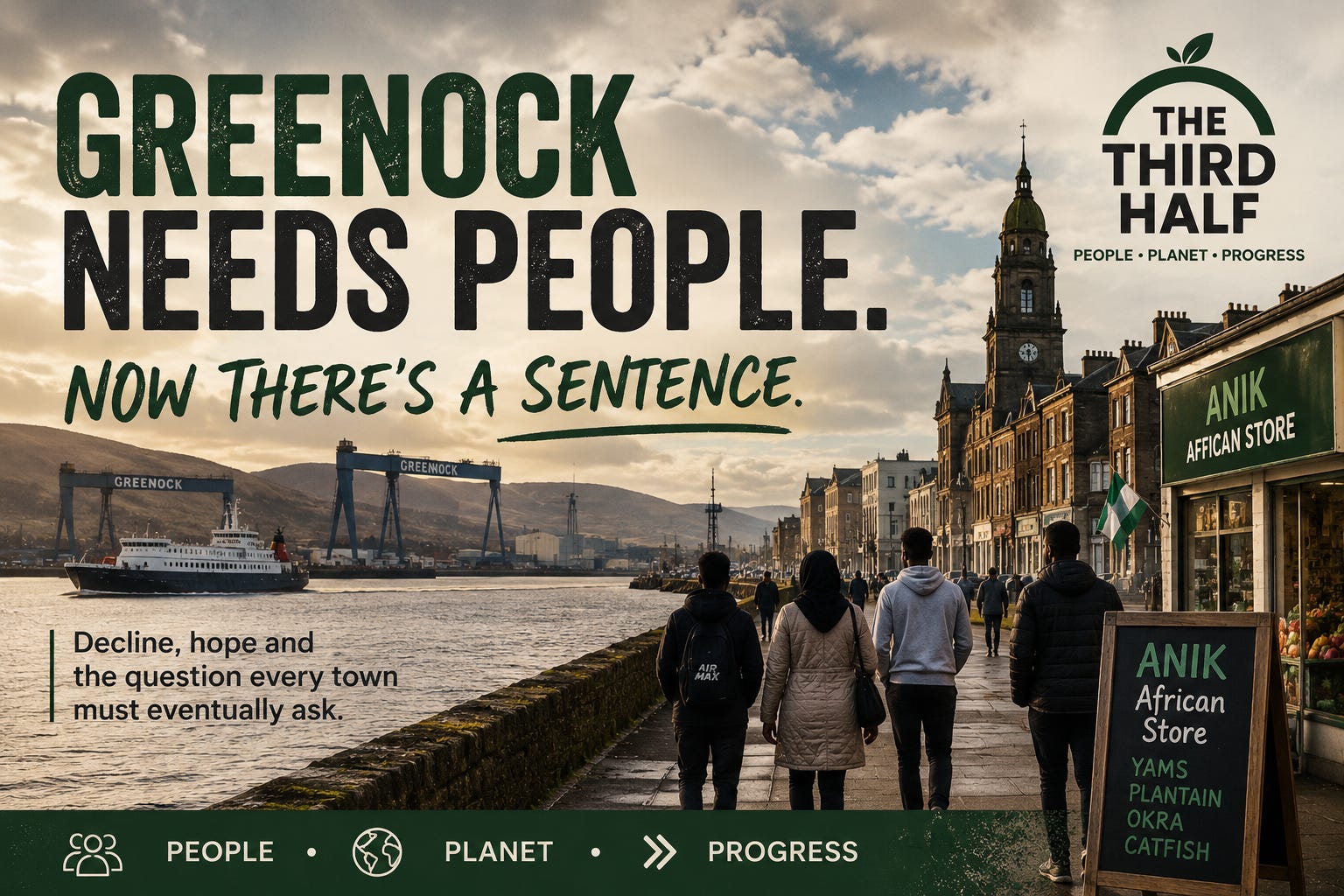
Greenock. Home of Morton FC, oft-times competitors of Airdrieonians. And a town I’ve long associated with IBM, where I spent a sizeable chunk of my working life. At one point IBM employed more than 5,000 people at its Greenock campus. I visited a few times when there were many less…. and there, kindov, starts the story.
I heard a BBC report on the radio today saying the local council actually wants more migrants to move there. And that’s not a story we’re hearing very often at the moment. I looked it up afterwards, and the piece underneath it is fascinating.
Inverclyde has 22,000 fewer people than it did in 1981. Its current population of around 78,000 is projected to fall another 16% over the next twenty years.
IBM has gone. Amazon has gone. EE has gone. Another 1,500 jobs have disappeared in just four years. As one woman in the BBC piece puts it rather more succinctly:
“When the work disappears, people disappear.”
And now Greenock has a problem. It needs people. Not in some abstract economic-model sort of way. It needs people to work in the hospitals and care sector. People living in the houses. Kids going to the schools. People spending money on the High Street. People paying council tax.
Increasingly, some of those people are coming from elsewhere. There are now hundreds of Africans living around Greenock, many working or studying in Glasgow and Paisley, attracted partly by relatively cheap housing. There are refugees from Syria, Ukraine, Afghanistan and elsewhere. African food shops have opened on a High Street where plenty of other things have closed.
The council wants more.
Now there’s a sentence to drop into the middle of the current UK immigration debate.
I’m not remotely suggesting there’s a simple answer here. There isn’t. Some locals quoted by the BBC make the fairly obvious point that if Greenock hasn’t got enough jobs for the people already there, bringing more people in isn’t magically going to fix that. And asylum seekers largely aren’t allowed to work while their claims are being processed, even when they desperately want to. The council itself thinks Inverclyde has been given a disproportionate share of asylum accommodation.
There have been tensions too. Some horrible ones.
So this isn’t a cosy little tale about immigration saving a Scottish town.
But it did make me think about something slightly different. Maybe we spend so much time arguing about people coming into Britain that we don’t talk enough about why people leave bits of it.
There’s a 19-year-old called Matthew Quinn quoted in the article who absolutely nails it:
“It’s not that people are desperate to leave, it’s that there’s no reason to stay.”
That’s the bit I keep coming back to. Because perhaps Greenock’s problem isn’t really immigration. It’s reasons to stay. Work, obviously. But also decent schools, transport, shops, places to eat, things happening, football clubs, music, community, opportunity. The stuff that makes somewhere feel alive.
There’s another guy in the piece, Derek Mitchell, trying to turn an old sugar refinery into an education hub for young people. He’s fed up waiting for somebody else to sort things out.
“If you build a sense of belonging, naturally and organically, people don’t want to leave.”
I like that.
And perhaps that’s where Greenock gets really interesting. Not because it has discovered that immigration is the answer. It hasn’t. But because it’s been forced to ask a question that quite a few more towns may eventually have to ask.
How do we make this a place where people actually want to live?
Whether they were born in Greenock, Airdrie, Lagos or Damascus seems almost secondary to that.
Although obviously, if they choose Greenock, we’ll need to have a word with them about supporting Morton.
The BBC’s original report, “The town whose council wants migrants to move in”, was published on 21 August 2026.