

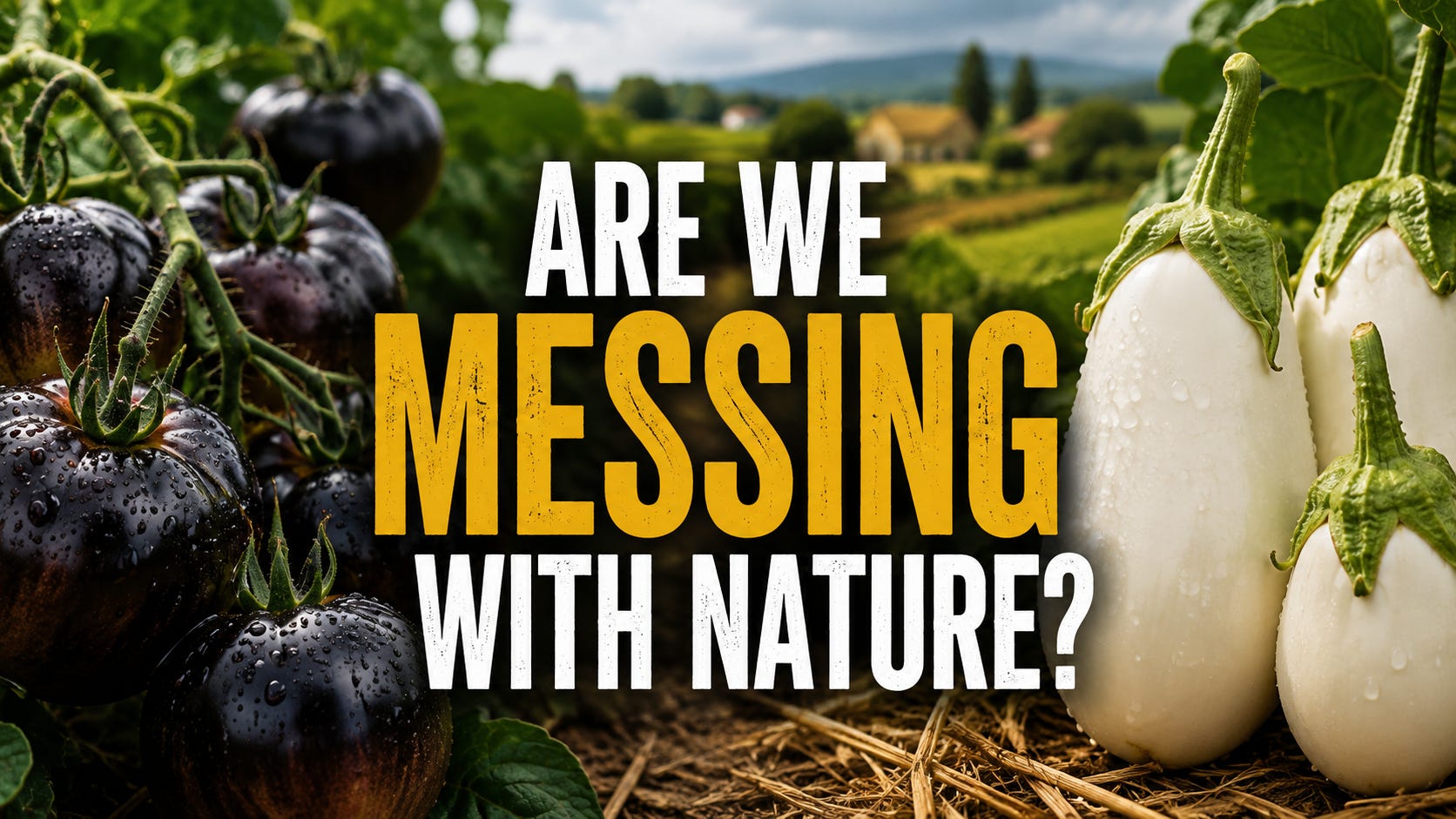
I know you’re all bored of me referencing Positive News, but here we go again. This time it’s black tomatoes, white aubergines and an Italian farm that thinks quantum physics might have something to do with the future of food. Obviously, I clicked.
Quintosapore is a family-run farm in Umbria growing around 1,500 varieties of fruit and vegetables. No pesticides, no tilling, microorganisms rather than synthetic fertilisers, seed saving, agroforestry, biochar. Lots here to like. I think. (If I knew what it all Meant). Then it gets a little stranger. Solar-powered speakers play particular frequencies to deter pests. Irrigation water is treated with electromagnetic frequencies. There’s even talk of reproducing the vibrational frequency of minerals such as calcium rather than simply adding more calcium.
Hang on, I thought. Aren’t we still messing with nature?
Of course we are. We’ve been selecting seeds, breeding animals, clearing land, moving water and deciding what grows where for thousands of years. Modern intensive agriculture has taken that considerably further through pesticides, synthetic fertilisers, monocultures and industrial-scale intervention, so perhaps the people at Quintosapore would argue they’re actually interfering less. They may have a point. Plants that survived the brutal 2022 drought are providing seeds for future crops. The soil is treated as a living ecosystem rather than simply something to stick plants into. Some biological inputs, the farm says, cost less than synthetic alternatives, and the business itself is growing.
I’d just recorded a Third Half conversation with Alex at Generation Soil. One teaspoon of healthy soil, he reckons, can contain billions of microorganisms. Once you start thinking about what’s happening beneath our feet, farming looks rather different.
But it also makes me wonder about unintended consequences. If you use sound to deter an insect, where does the insect go? What does that frequency do to pollinators or other beneficial insects? If you introduce microorganisms to change the soil, what happens to the ones already there? And if you continually select plants that survive drought, heat or disease, are you helping nature adapt, or deciding what you want nature to become? There may be very good answers to all of this.
There’s another reason for a little caution too. “Quantum” is one of those words that can make something sound scientifically impressive without the science itself being impressive. Quantum physics is real, that doesn’t mean every idea with “quantum” attached to it has been proven, and some of these claims need proper independent evidence. Dismissing the whole thing because some of it sounds bonkers would be equally lazy, though. Agriculture has enormous problems to solve, soil degradation, biodiversity loss, water scarcity, climate change, chemical dependency, and rather importantly, the need for farmers to make a living while still producing enough food for the rest of us. We need people willing to experiment. Some experiments will work, some won’t, some things that sound ridiculous today might become perfectly normal, and some will indeed turn out to have been ridiculous.
Perhaps the question isn’t whether we should interfere with nature. We already do. It’s how much, in what way, based on what evidence, and what else happens when we do. I think I need to talk to these people. And I definitely need to try a black tomato.
What do you think? Clever way of working with nature, or are we getting a little too clever for our own good?
#PeoplePlanetProgress #RegenerativeAgriculture #SustainableFarming #Biodiversity #SoilHealth #TheThirdHalf
Great article Scottie and it's very good to open an incredibly and increasingly important debate.
My own take is that with a still growing population ( globally) we need to think extremely carefully about ' what next and ' how ' in agro farming ' .
I was, and still am impressed with vertical farming and the circularity it provides. The EUs backwards looking ideas on gene editing/splicing and disease resistance needs revisiting as does the UKs reset and alignment with EU SPS measures with little economic value to us.
Science/agro science really ought to be forwards looking and not be beholden to large European cartels/technocrats - we can do better than that as your article demonstrates.