

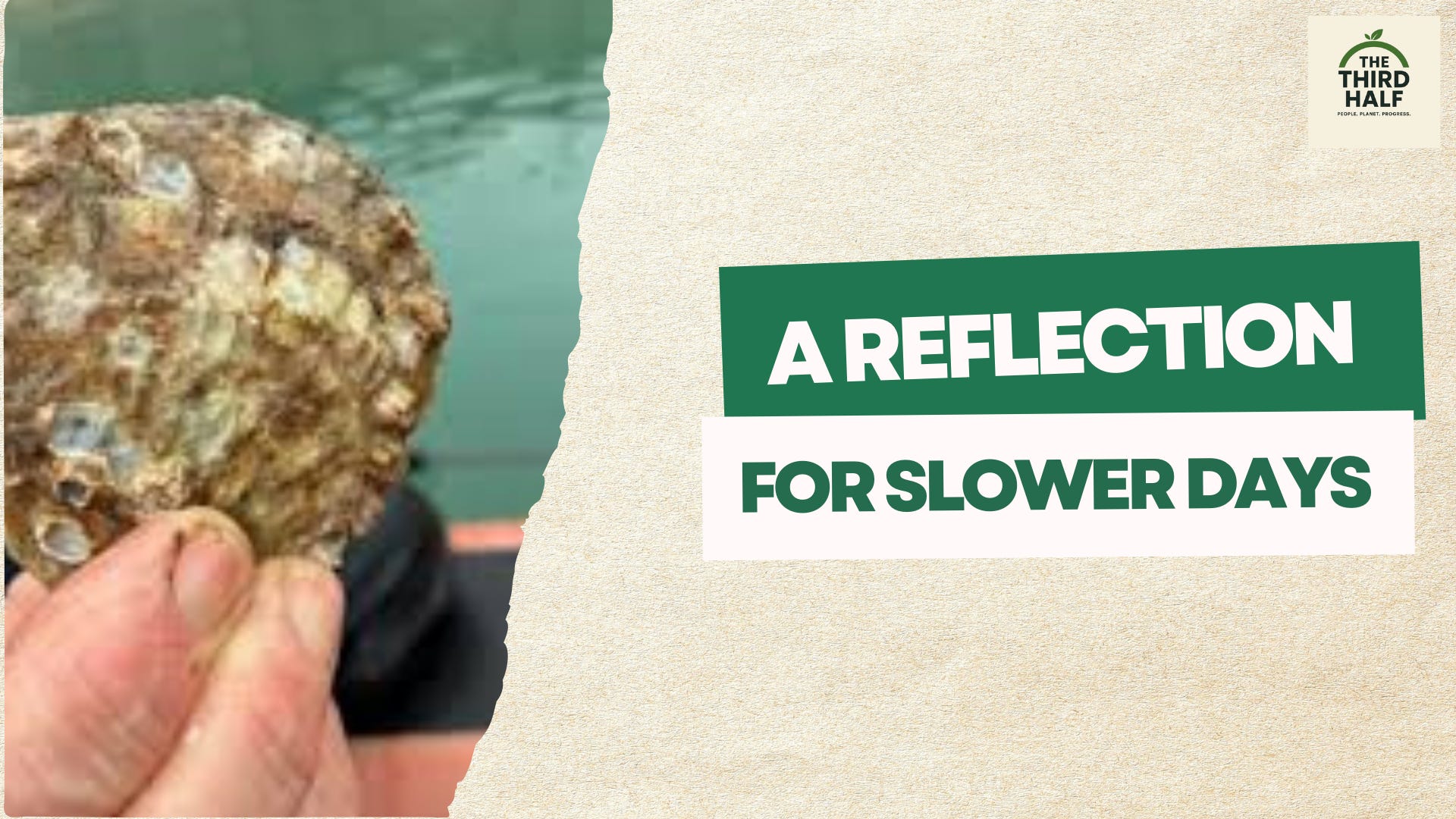
There’s a gentle story unfolding in Dublin Bay. No launch event. No glossy deck. No influencer reel. Just oysters — native European flat oysters — being lowered back into waters they once ruled, long before we industrialised the edge cases and congratulated ourselves on efficiency.
It’s the sort of story that slips past the weekday news cycle. Too slow. Too patient. Too unassuming. But on days when the pace drops — Sundays, or moments that feel like them — it’s exactly the kind of thing that invites reflection. The noise fades. The timeline scroll slows. You notice different things.
Each oyster filters the water. Not dramatically. Not heroically. It just does the work it has always done. Day after day. In time, the water clears. Seagrass returns. Fish follow. The system begins to remember what it used to be.
There’s a lesson here, and it isn’t really about oysters.
We’ve grown addicted to speed. To disruption. To solutions that fit neatly into quarterly updates and funding rounds. Even sustainability has been forced into this shape — targets, offsets, dashboards, urgency layered on urgency. Progress, we’re told, must be loud to be real.
But nature doesn’t work that way. Neither does leadership worth having.
The oyster project in Dublin Bay isn’t trying to “solve” the climate crisis. It isn’t promising a hockey-stick outcome. It’s restoring a function. Reintroducing a role into a wider system and trusting the system to respond. The real payoff — if it comes — will arrive quietly, over years, maybe decades. Long after the original volunteers have moved on.
That’s uncomfortable for us. It doesn’t photograph well. You can’t rush it. And you certainly can’t fake it.
In business, in technology, in public life, we’ve become very good at announcing intent and very bad at sustaining effort. We reward the declaration more than the discipline. The oyster asks something different of us: patience, humility, and the willingness to do work that may never carry our name.
There’s something deeply human in that, even if it runs against the grain of modern professional life.
On slower days — the kind my good friend Rashik Parmar captures so well with his Sunday Sprinkles — this feels less like an argument and more like a reminder.
A nudge to value the unglamorous things again.
The slow rebuild.
The maintenance job.
The quiet contribution that makes everything else possible.
Not every form of progress needs a spotlight.
Some of it just needs time — and for us to stop getting in the way.
https://www.theguardian.com/world/2026/jan/18/dublin-bay-oyster-reefs-restoration