

On The Third Half, we talked about soil recently with Alex Montgomery of Generation Soil. This morning I read an article in the paper that therefore resonated straight off, and then hit quite hard.
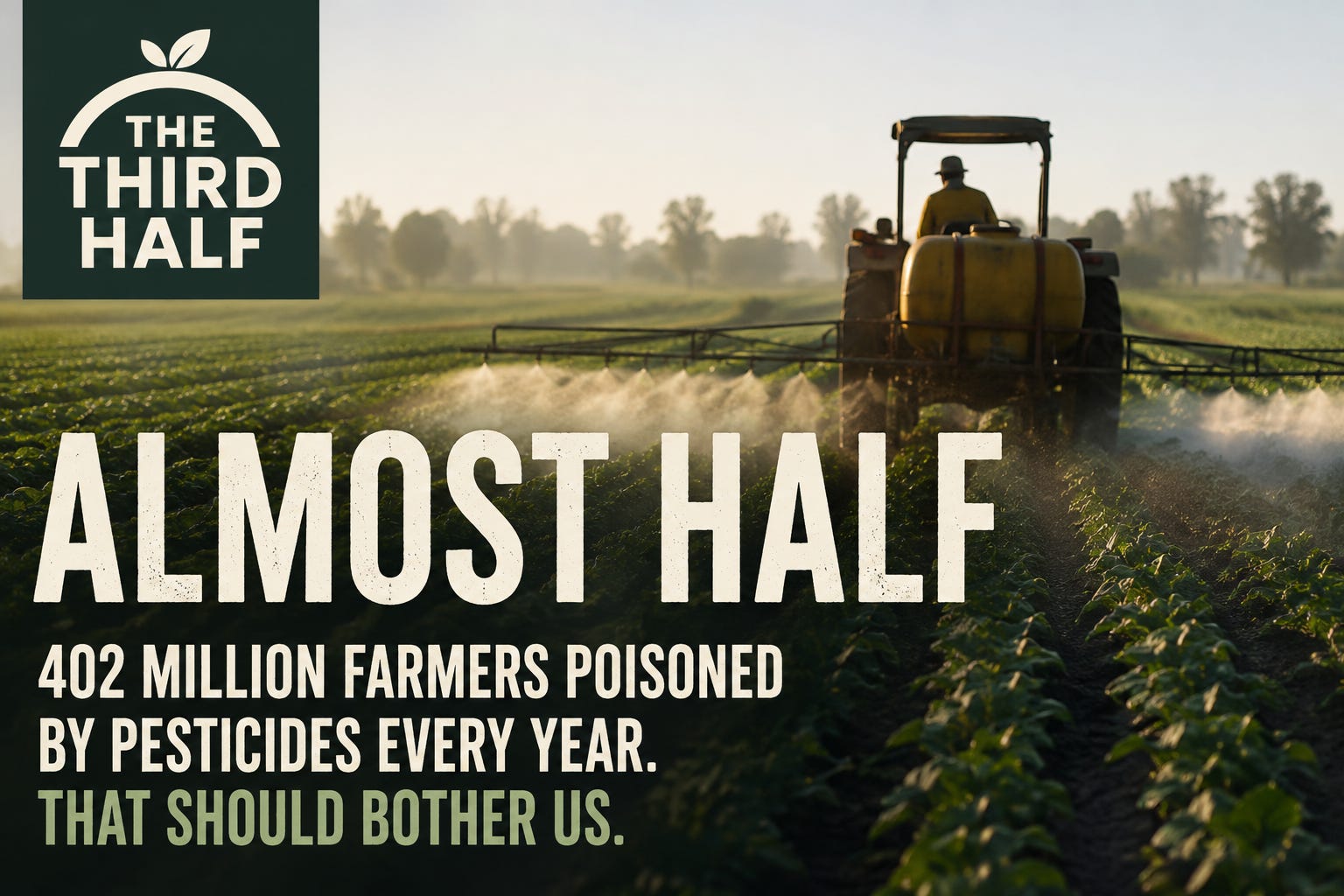
46%. Almost half of the world’s farmers and farm workers are being poisoned by pesticides every year. Not exposed to them. Poisoned by them.
A new study, reported by The Guardian today, estimates 402–433 million cases of acute, unintentional pesticide poisoning every year among a global farming population of 934 million. It estimates another 11,000 people die every year as a result.
And pesticide use is going up, not down. In 2023, 3.8 million tonnes were used globally, twice as much as in 1990.
Those numbers are difficult to get your head around. But one sentence immediately chimed loud
“We are just taking food and not giving anything back.”
When I sat down with Alex a few weeks ago, we were meant to be talking about food waste and composting. But, as often happens on The Third Half, the conversation ended up somewhere much bigger.
Alex talked about our relationship with soil. “The relationship we currently have with soil isn’t a reciprocal relationship. We are just taking food and not giving anything back.” And then this. “What we are giving back is harmful pesticides and fertilisers which damage the soil health, the microbial health, our own health.”
Our own health. That’s quite a different message.
It’s easy to make soil health sound worthy and slightly abstract, something involving compost bins, worms and people who know considerably more about gardening than I do. (I had a wormery once, when the kids were young. It was a disaster). But it isn’t. Soil is where our food comes from. Farmers are the people who grow it. And we have somehow built a food system in which hundreds of millions of those people are being poisoned by the chemicals used to produce that food.
The study doesn’t even attempt to quantify the long-term health effects. Nor does it include the estimated 84 million children working in agriculture. Think about that for a moment.
This isn’t anti-farming. Quite the opposite.
Farmers are being asked to feed more people, produce food cheaply, cope with increasingly unpredictable weather and somehow make a living at the end of it. The answer cannot simply be to wag a finger at them and tell them to stop using pesticides.
The researchers want farmers given access to safer alternatives, and the most hazardous pesticides phased out. That’s a sensible place to start.
But perhaps there’s a bigger question too. What kind of food system have we built if poisoning the people producing our food has become an accepted cost of feeding ourselves?
Back to the soil
Alex wasn’t arguing that everyone needs to sign up to Generation Soil. He told people who can compost themselves not to pay them to do it. His point was simpler. We take from the soil. At some point, we have to start putting something good back. Fresh organic matter. Nutrients. Life. Not just more chemicals.
When we spoke, that felt like a conversation about soil. Today it feels like a conversation about people too. 402 million of them, at the very least.
That should bother us. A lot.